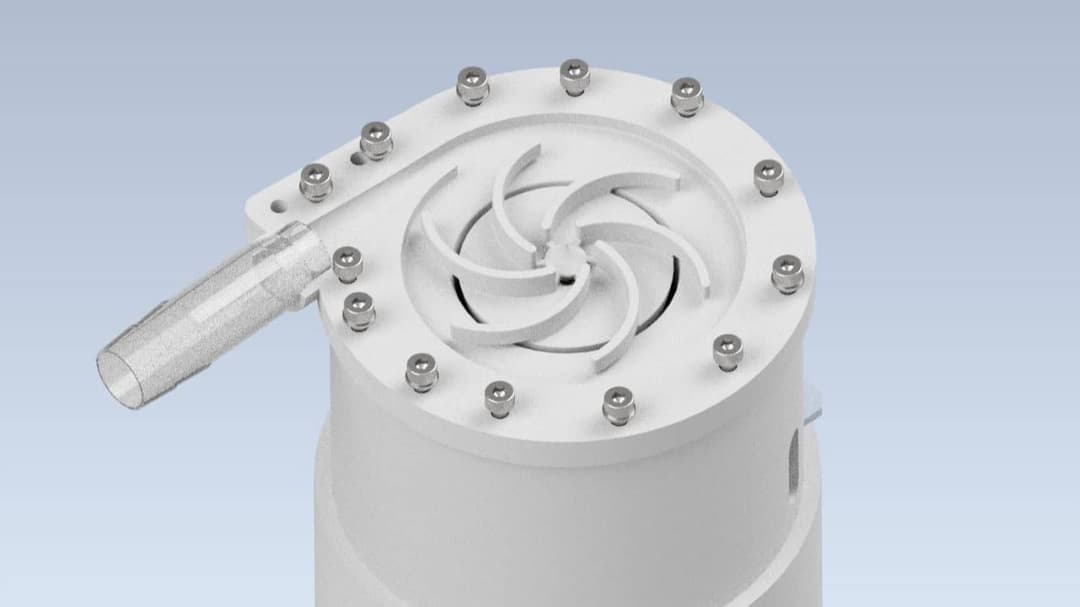
About the author
Fabian Schalla (M. Sc.) is a Project Engineer at evos GmbH, a young engineering company founded in 2020 and based in Würselen near Aachen, Germany. evos develops tailored technical solutions with a strong focus on medical technology. One of its key areas of expertise is the development of blood pumps, both optimizing existing pump designs and developing new concepts. The development process combines theoretical approaches, such as CFD simulations, with practical testing in the company's own laboratories.
Blood pumps
Our project focuses on a blood pump for extracorporeal circulation. Such pumps are mainly used in ECMO and ECLS therapy, where a blood pump temporarily takes over the function of the lungs, or of both the heart and the lungs. The aim is a pump that reaches a high hydraulic operating point while covering a broad range of operating conditions.
Besides hydraulic performance, a blood pump must handle blood as gently as possible. Blood damage refers to the damage caused to blood cells and proteins when blood is exposed to excessive mechanical forces or artificial surfaces. It can, for example, destroy red blood cells or affect platelets. In extracorporeal circulation, severe blood damage can lead to hemolysis, blood clotting or bleeding complications, which makes minimizing it a key requirement for a safe and effective blood pump.
Design challenges
Technical pumps are generally designed for maximum efficiency, which is often achieved through very narrow clearances and specific geometries. However, certain design features that ensure high efficiency also result in a high level of blood damage. The challenge in developing a blood pump is therefore to achieve the highest possible efficiency while at the same time minimizing blood damage.
A second challenge is the wide range of operating points that are set in the clinic. The pump must keep blood damage to a minimum at both low and high flow rates. In short, we're looking for a pump that is powerful, flexible, efficient and gentle to the blood.
CFD simulations
We used AirShaper internal flow simulations to analyze the pump head. The impeller was defined as a rotating object, with flow openings at the inlet and the outlet. Besides the full flow field through the pump, the simulations provide the hydraulic performance values, such as the pressure rise, power and torque, which we could compare one-to-one with our test bench measurements.
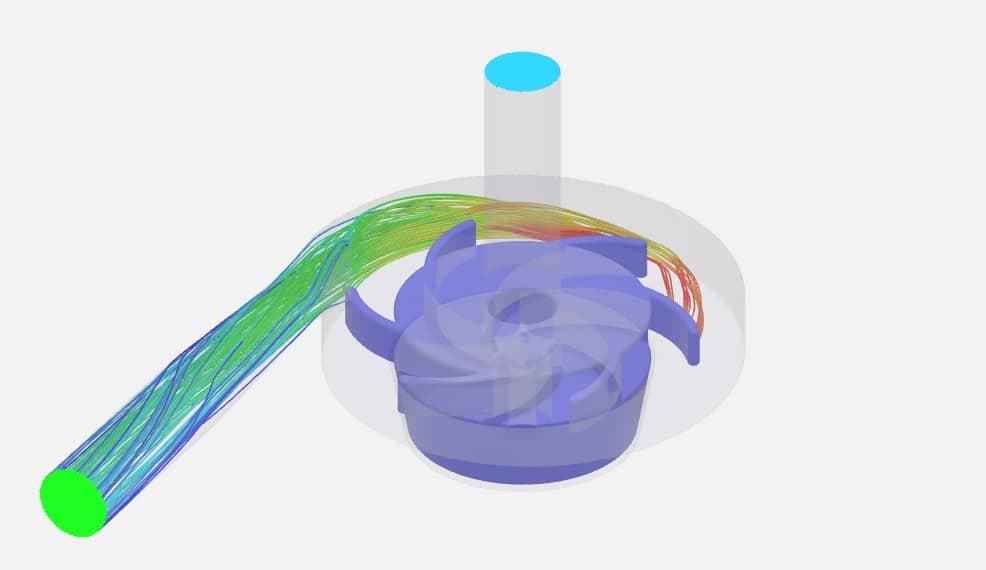
In the simulations, we observed flow patterns in the inlet and outlet regions that were unfavorable in terms of blood damage. Using the AirShaper simulations and blood damage calculations, we were able to develop design variants that mitigated these problem areas. For confidentiality reasons, the specific design changes are not disclosed.
Blood damage modeling
There are various ways of calculating the damage to blood cells. A fundamental assumption is that shear stress, in combination with the duration of exposure, has a significant influence on red blood cell damage. Put simply: a blood cell can be exposed to very high shear stress for a very short period without sustaining damage, and conversely, to very low shear stress for a very long period. Once a certain threshold is reached, either because the exposure time becomes too long or the shear stress too high, the cell sustains irreversible damage. These limits cannot be clearly defined and are highly complex.
In collaboration with Nico Dirkes of the Chair for Computational Analysis of Technical Systems (CATS) at RWTH Aachen University, the AirShaper simulation results were further processed and the damage to the blood cells was calculated using a strain-based approach [1, 2]. This enables us to analyze and optimize different pump designs even before blood tests are performed.
Physical testing
Pump performance is tested in our in-house hydraulic laboratory to determine parameters such as flow rate, pressure and efficiency at different operating points. In addition, blood tests are performed to evaluate the pump's impact on blood, particularly hemolysis and blood damage. The results are compared against defined performance and blood-compatibility criteria.
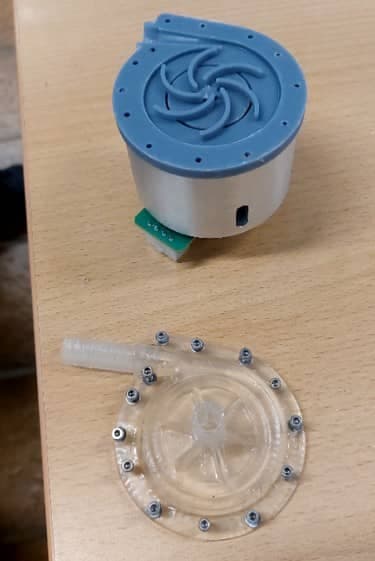
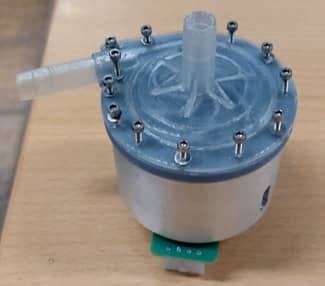
To match the simulation results with reality, we developed various test benches: from simple pressure measurement (Δp), through power and torque measurement, to axial force measurement using a miniature force sensor. Simulation and test bench were compared at identical conditions, i.e. the same flow rate and rotational speed.
Results
All simulation results were confirmed by the measurements with very little deviation. The pressure rise matched within 1%, while power and torque were within 4%. The simulation slightly overpredicted the pressure rise and slightly underpredicted the power and torque.
| Parameter | Deviation (simulation vs. test bench) |
|---|---|
| Pressure rise (Δp) | +0.6% |
| Power | −3.6% |
| Torque | −3.7% |
| Axial force | Confirmed with very little deviation |
Deviation = (simulation − measurement) / measurement. Absolute values are not published for confidentiality reasons.
Conclusion
Setting up these test benches was a significant initial effort, but it has given us the confidence that we can rely on AirShaper's simulation results. When new variants are developed, random comparative measurements are now sufficient, which significantly increases our development efficiency.
We have found AirShaper to be a very helpful and reliable tool that enables us to carry out simulations quickly and with a high degree of precision. The user interface is very intuitive and user-friendly. Whenever we did have any questions or problems, Wouter was always on hand and quickly helped us out.
References
- Dirkes, N., Key, F. and Behr, M., 2024. Eulerian formulation of the tensor-based morphology equations for strain-based blood damage modeling. Computer Methods in Applied Mechanics and Engineering, 426, 116979. doi.org/10.1016/j.cma.2024.116979
- Dirkes, N. and Behr, M., 2026. A Practical Computational Hemolysis Model Incorporating Biophysical Properties of the Red Blood Cell Membrane. arXiv preprint. arxiv.org/abs/2601.19994