A drone's flight time, payload and range depend to a large degree on how much power it needs to stay in the air, and much of that power goes into aerodynamics: the drag of the airframe, the lift-to-drag ratio of the wing and the efficiency of the propellers. On fixed-wing drones in particular, small variations in wing profile, camera position or winglets can have a substantial effect.
CFD (computational fluid dynamics) simulates the airflow around a 3D model of the drone. AirShaper runs these simulations in the cloud as a virtual wind tunnel: you upload the model, set the flight condition and get forces, moments and flow visualizations back. Below: what that tells a drone designer, what drone teams have achieved with it, and how the results were validated.
What CFD tells a drone designer
A wind tunnel or a flight test tells you how a drone performs. A simulation also shows why, because the complete flow field is available: where the flow separates, which parts of the airframe leave a wake, and how the air moves through the propellers. From an AirShaper simulation you get:
- Forces and moments: lift, drag and their coefficients, plus the pitch, roll and yaw moments that determine trim and stability.
- Stability derivatives: static and dynamic stability derivatives can be calculated with AirShaper, as input for the flight dynamics model and the flight controller.
- Flow visualizations: surface pressure and friction maps, 3D streamlines, and pressure clouds that show where energy is lost in the flow.
- Propeller data: with rotating propellers in the model, the thrust, torque and power on each propeller at its RPM.
- Comparisons: drag, lift and coefficients side by side across design variants.
- Shape optimization: AirShaper's shape optimization is available for both the airframe and the propellers.
Simulations run as steady-state RANS with the k-omega SST turbulence model, on a mesh that is refined automatically around the geometry, which suits most scenarios. AirShaper also offers transient simulations, which capture how the flow develops over time. They are most interesting where the flow is strongly unsteady, such as designs with a lot of interaction between the propellers and the airframe or between the propellers themselves, or with vortex shedding and oscillating wakes. For an example, see this transient simulation of a Jetson eVTOL.
Fixed-wing drones
In cruise, the wing of a fixed-wing drone carries the weight and the propeller only has to overcome drag. Along with battery capacity and weight, the lift-to-drag ratio (L/D) at the cruise condition therefore largely determines endurance, which puts the focus on airfoil choice, wing planform, winglets, and how the fuselage and payload blend into the wing.
A sweep over a range of angles of attack gives the lift and drag curves of the complete aircraft, including the interference between wing, fuselage and payload that a 2D airfoil analysis leaves out. The flow visualizations then show where the losses sit. In our 3D flow analysis of a generic fixed-wing drone, a simulation at a deliberately aggressive 15° angle of attack showed separated flow on the outer wings while the center section stayed attached: a gradual onset of stall, which can make a drone easier to fly at the limit. The airfoil selection guide and the winglet explainer cover the theory behind both.
Multirotors
A multirotor uses its propellers for lift all the time. That makes it maneuverable, but it also means it needs a lot of power just to hover. Two things matter aerodynamically: the propellers themselves, and the drag of the airframe in forward flight, where arms, landing gear and camera sit in the oncoming flow and partly in the propeller wake.
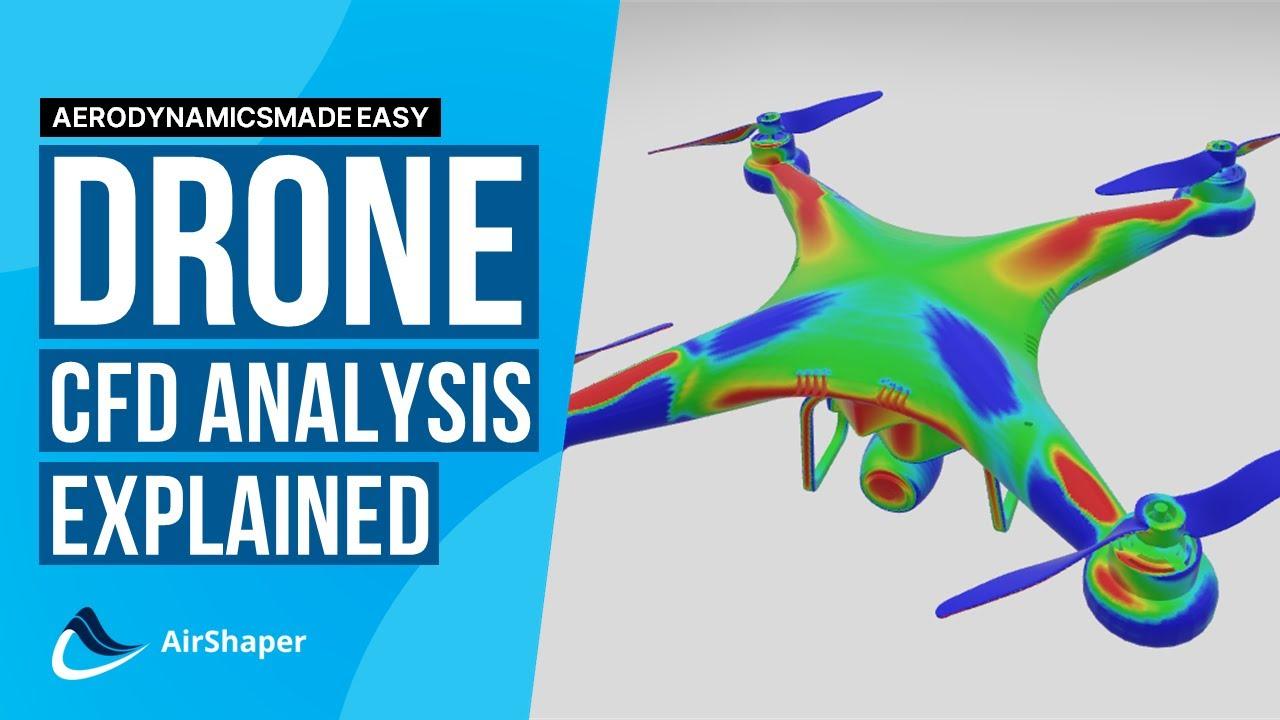
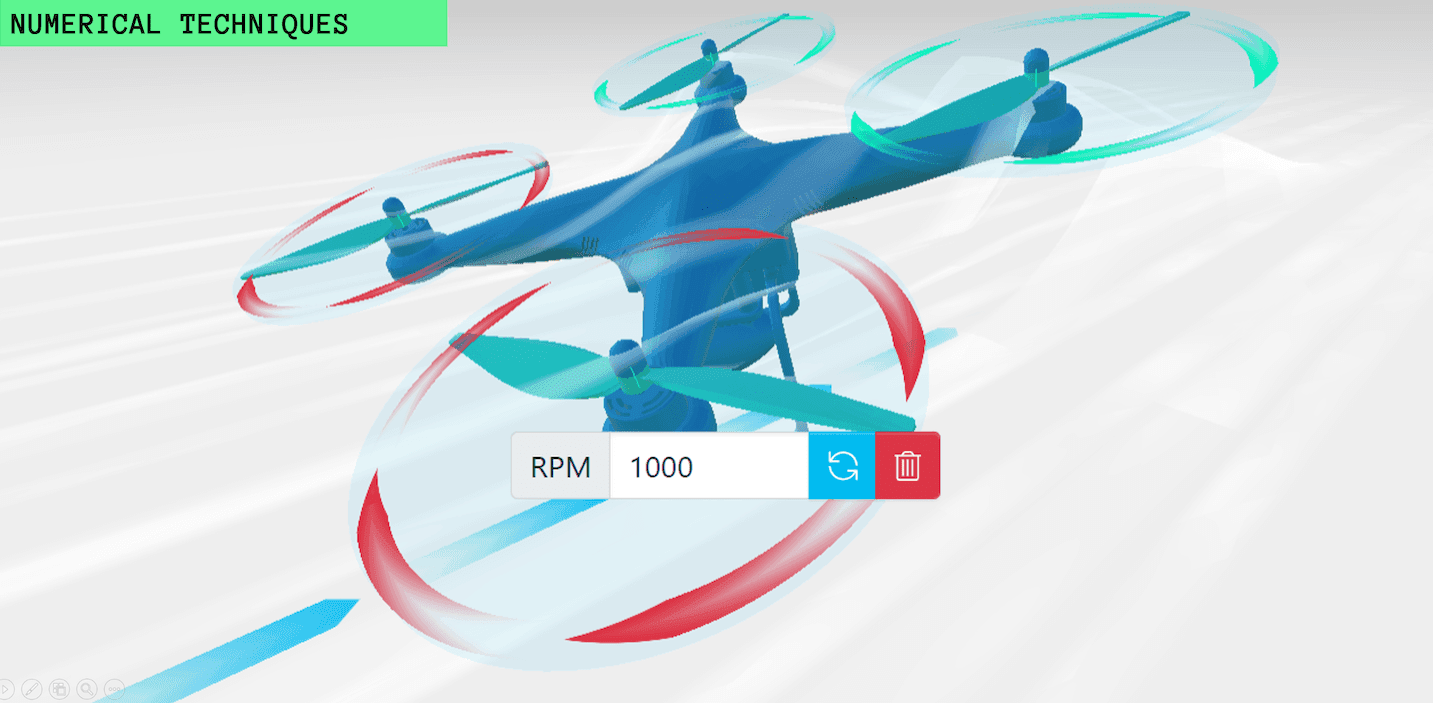
Modeling the rotating propellers puts that propeller wake into the simulation. In the step-by-step analysis below, a modified DJI Phantom, based on a publicly available 3D model, is pitched forward with its propellers rotating. The pressure clouds point at drag from the landing gear, the camera, slots in the airframe and the propellers themselves, and the surface pressure shows the load on the support arms in the wake of the propellers.
VTOL and eVTOL
A fixed-wing VTOL drone takes off and lands on its rotors, then transitions to wing-borne flight. It has to work in two opposing flight modes: stable in hover, and efficient and stable in cruise, even in turbulent crosswinds. Running the same model with and without rotating propellers shows how much the rotors change the flow. For lift propellers that only run in hover, it is also worth checking that flight characteristics stay the same when they are not turning.
The same approach scales up to passenger aircraft. The sample simulations include a four-passenger eVTOL air taxi with 12 propellers, and the eVTOL CFD analysis video walks through how to read the results of such a simulation.
A typical drone simulation
- Upload the 3D model. Gaps and holes are accepted, so the CAD does not need to be repaired first.
- Set the flight condition: a flying drone is simulated above the ground and moving, at its airspeed and angle of attack.
- Add the propellers and give each one a rotational speed.
- Run the variants you need, such as an angle-of-attack sweep or alternative designs, and compare them side by side.
- Use design advice to see which areas of the airframe contribute most to lift or drag.
Results from drone teams
Wingtra: more payload from a simulation-first workflow
Wingtra builds fixed-wing VTOL drones for mapping and surveying. For the WingtraRAY, a tailsitter VTOL UAV, the team involved AirShaper from the ideation and sizing stages and evaluated over 180 airframe variants in six months, including wildcard ideas such as radical winglet-to-wing transitions. When a new camera or sensor is integrated, Wingtra simulates how it affects drag and shapes the enclosure to limit flow separation. The result was a 12% increase in aerodynamic efficiency (L/D), 56% more payload capacity by weight and 59% by volume, and flight times of 60+ minutes. Read the Wingtra case.
senseFly: 30% more aerodynamic efficiency on the eBee-X
senseFly builds fixed-wing mapping drones, where every extra minute of flight time counts. senseFly, AirShaper and WindShape combined field testing, simulations and wind tunnel testing: monitoring on the drone flagged challenging flight regimes, the wind tunnel studied them up close, and simulations compared and ranked new designs before they were built. The aerodynamic modifications did not affect weight or structural integrity and gave a 30% increase in aerodynamic efficiency on the eBee-X. Combined with the latest battery improvements, the eBee-X flies for up to 90 minutes. Read the senseFly case.
Peregreen V4: the fastest battery-powered quadcopter
Luke Maximo Bell and his father Mike set out to build the world's fastest battery-powered quadcopter. Their V3 prototype suffered violent side-to-side oscillations above 350 km/h; simulating the airflow and center of gravity placement in AirShaper led them to a design with passive stability. For the V4, the simulations showed that a slightly larger, more contoured body was more efficient than a smaller, boxier one. The V4 set the official Guinness World Record at an average of 657 km/h (408 mph), with a peak of 659 km/h (409 mph). Read the Peregreen case.
How the results were validated
Two AirShaper users gave clearance to share their simulation results and compare them with wind tunnel data on drone hardware: one on a complete airframe, one on a propeller.
Wingtra: lift and drag of a fixed-wing VTOL drone
Years earlier, Wingtra had found poor correlation between 3D CFD and its wind tunnel tests, and fell back on fast but rudimentary tools such as XFLR5. When the team re-evaluated CFD with AirShaper, it compared the simulated lift and drag curves with wind tunnel measurements taken on a measuring balance, after correcting for air density, blockage and the forces on the mounting structure. The correlation was very good. Wingtra now uses CFD with confidence, at its peak running over 100 simulations per person per month, while noting that it will not replace wind tunnel or flight testing altogether. Read the Wingtra validation.
Mejzlik: propeller thrust, power and efficiency
Mejzlik Propellers measured its 21x13 propeller (21-inch diameter, 13-inch pitch) at a constant 4900 RPM in a wind tunnel at the University of Defence in Brno, and compared the data with AirShaper and with its in-house tool based on blade element momentum (BEM) theory. All methods captured the correct trends, and the CFD methods were more accurate than the BEM method, at a higher computational effort. The Regular simulations (10 million cells) with prism layers gave a near-exact match with the wind tunnel data across advance ratios from 0.0 to 0.6. Beyond that, near the point where the propeller starts windmilling, the wind tunnel measurements suffered from blockage: the propeller starts to act like a disc blocking the flow, an effect the simulations do not have, so the two diverge there. Read the Mejzlik validation.
More studies, including DARcorporation's comparison of a Cessna 210 with NASA wind tunnel data, are on the validation page.
Research and further reading
Research
- Automated drone design with deep learning: Neural Concept, EPFL and AirShaper optimized the shape of a senseFly fixed-wing drone with a neural network trained on AirShaper simulations. With 40 detailed simulations, L/D increased by 4.25% and drag fell by 6.25% at maximum L/D; the optimized shape has more anhedral, inward-tilted winglets and a more cambered fuselage.
- Simulating the rotating elements of a quadcopter in OpenFOAM: a thesis, written as AirShaper investigated rotating elements, that compares the SRF, MRF and AMI methods for modeling propellers on accuracy, computational cost and feasibility, using the propellers of a DJI Phantom 3.
Articles
- How CFD can optimize VTOL drone design: quadcopters versus fixed-wing VTOL drones, integrating propellers into the airframe, and modeling rotating elements.
- AI propeller design optimization: FRIENDSHIP SYSTEMS linked CAESES parametric propeller models to AirShaper through the API and trained surrogate models on the CFD thrust and torque results, helping it win a propeller design competition. The method applies to aerodynamic and hydrodynamic propellers.
- Flapper Drones and bio-inspired flight: Matěj Karásek on drones that fly by flapping their wings instead of using propellers, and why their unsteady aerodynamics are hard to model.
- eVTOL certification interview with EASA: the challenges of certifying eVTOL aircraft and their propellers.
Videos
- Drone design 1: selecting an airfoil
- Drone design 2: 3D flow analysis
- Drone CFD analysis explained, step by step
- eVTOL CFD analysis explained, step by step
- How to model rotating elements in CFD: MRF, AMI and more
- How winglets improve aerodynamics
- Drone propeller noise reduction: a bio-inspired blade with tubercles compared with a stock DJI propeller
- NASA X-57 Maxwell interview, part 2: propeller design